
By Al Drinkle
Each wine lover carries within them a short, cherished list of names that inspire emotional, spiritual, and literal salivation. As a veritable cornerstone of German Riesling, the name Dönnhoff has long stirred this sort of awe and wonder in me.
Early on in my German wine journey, I was standing above the ruins of the Ehrenfels castle in Rüdesheim's Berg Schlossberg vineyard, getting the lay of the land from Johannes Leitz. From this western outpost of the Rheingau, one can see the Nahe River emptying into the Rhein, marking the confluence of the Rheingau, Rheinhessen, and Nahe wine regions.
“And over there,” Leitz pointed, concluding his detailed and still resonant explanation, “east of the Hünsruck mountains is the Nahe, where Helmut Dönnhoff makes the greatest Rieslings in Germany.” This bold statement was made casually but categorically, and coming from Leitz one can take for granted that “the greatest Rieslings in Germany” are also the greatest Rieslings in the world.
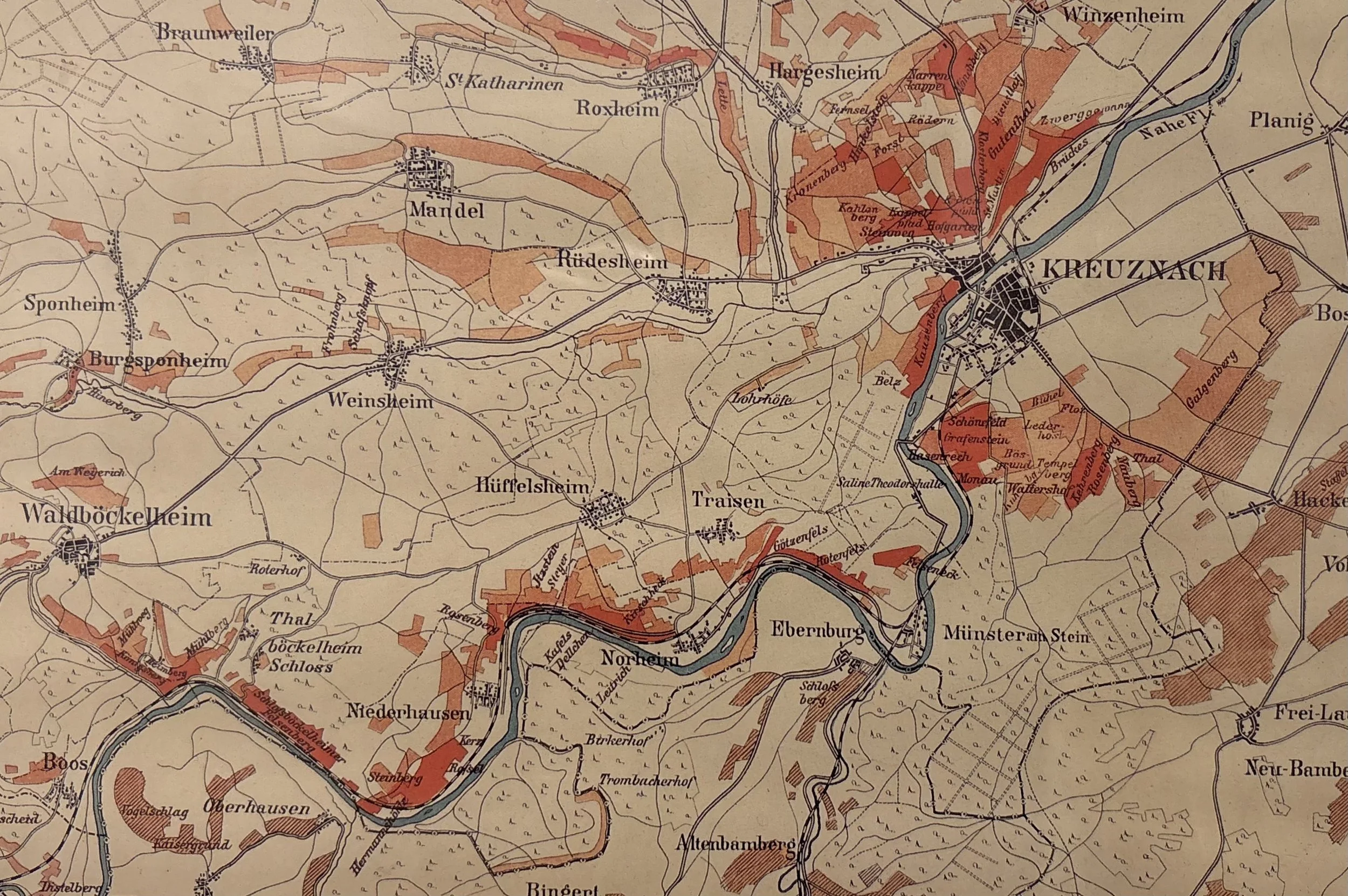
To say that Dönnhoff is synonymous with the compact Nahe region is to slightly underestimate the relationship. For centuries, the Nahe’s borders were undefined and its wine was usually traded simply as “Rhein wein”. It's pure coincidence that Helmut Dönnhoff took over his family estate in 1971, the exact same year that the Nahe was officially demarcated as a region, but it's no exaggeration to say that the identity of the Nahe owes a great deal to the indefatigable work and talent of Dönnhoff.
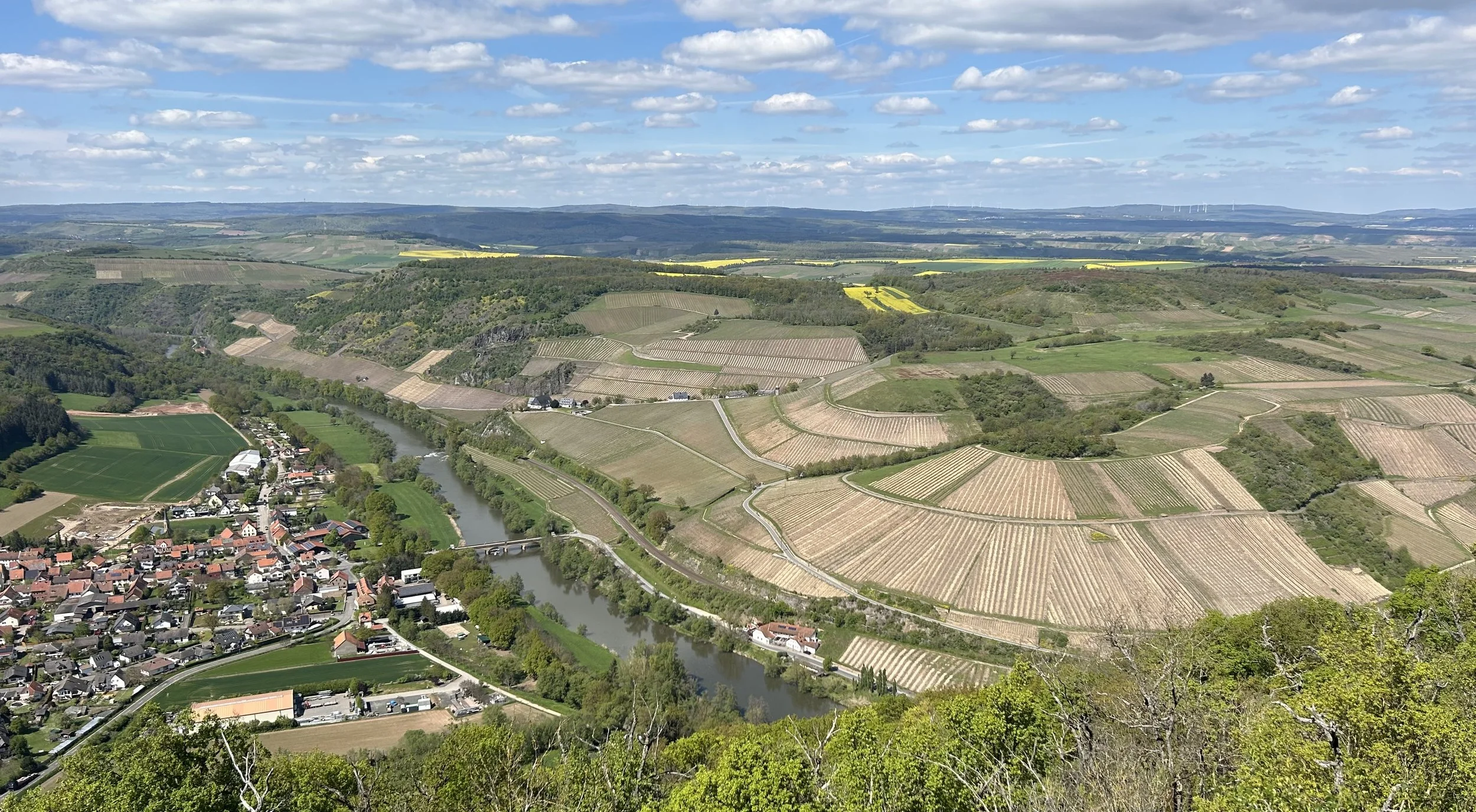
Oberhäusen an der Nahe
Nahe Riesling is often described as sitting somewhere between the Rheingau and the Mosel in personality, and though this isn't necessarily misleading in either a stylistic or geographical sense, it’s not particularly satisfying ¹. The Nahe's best Rieslings may vaguely combine the Rheingau's broad-shoulders with the Mosel's piquancy, but it would be facile to leave it at that. In an attempt not to get carried away, I'll propose that while they can exhibit power, Nahe Rieslings are rarely ponderous, and that neither weight nor intensity tends to obscure their cool-toned, brilliant detail. At their most strapping they’re sinewy as opposed to muscular, and on the other end of the spectrum, they can be electric and scintillating, but stopping short of actual delicacy.
Confused? Perhaps part of the explanation as to why the Nahe's Rieslings can be so complex but also confounding to describe is that it's the most geologically diverse of Germany's 13 wine regions. As just one example of this, Dönnhoff's enviable holdings in the Hermannshöhle vineyard boast an unlikely combination of grey slate, volcanic porphyry, and limestone—all in immediate proximity! More saliently, it's hard to imagine a Riesling lover not loving Nahe wines, and one who claimed they didn't would have a difficult time persuading me that their convictions have any grounding.
Given the historical underappreciation of the region—along with a decline of initiative among his colleagues to pursue steep-slope viticulture—Helmut was able to expand his family's holdings over the decades by obtaining parcels in some of the most extraordinary vineyards of the central Nahe. There's Leistenberg and Brücke from his home village of Oberhausen; choice Felsenberg parcels in Schlossböckelheim; Hermannshöhle and Klamm in Niederhausen; Dellchen and Kirschheck in the village of Norheim; Krötenpfuhl and Kahlenberg on the outskirts of Bad Kreuznach; and Höllenpfad in Roxheim—each with outstanding potential. More importantly, in the hands of Dönnhoff the various sites exhibit starkly different personalities, or “talents” as Helmut likes to put it.
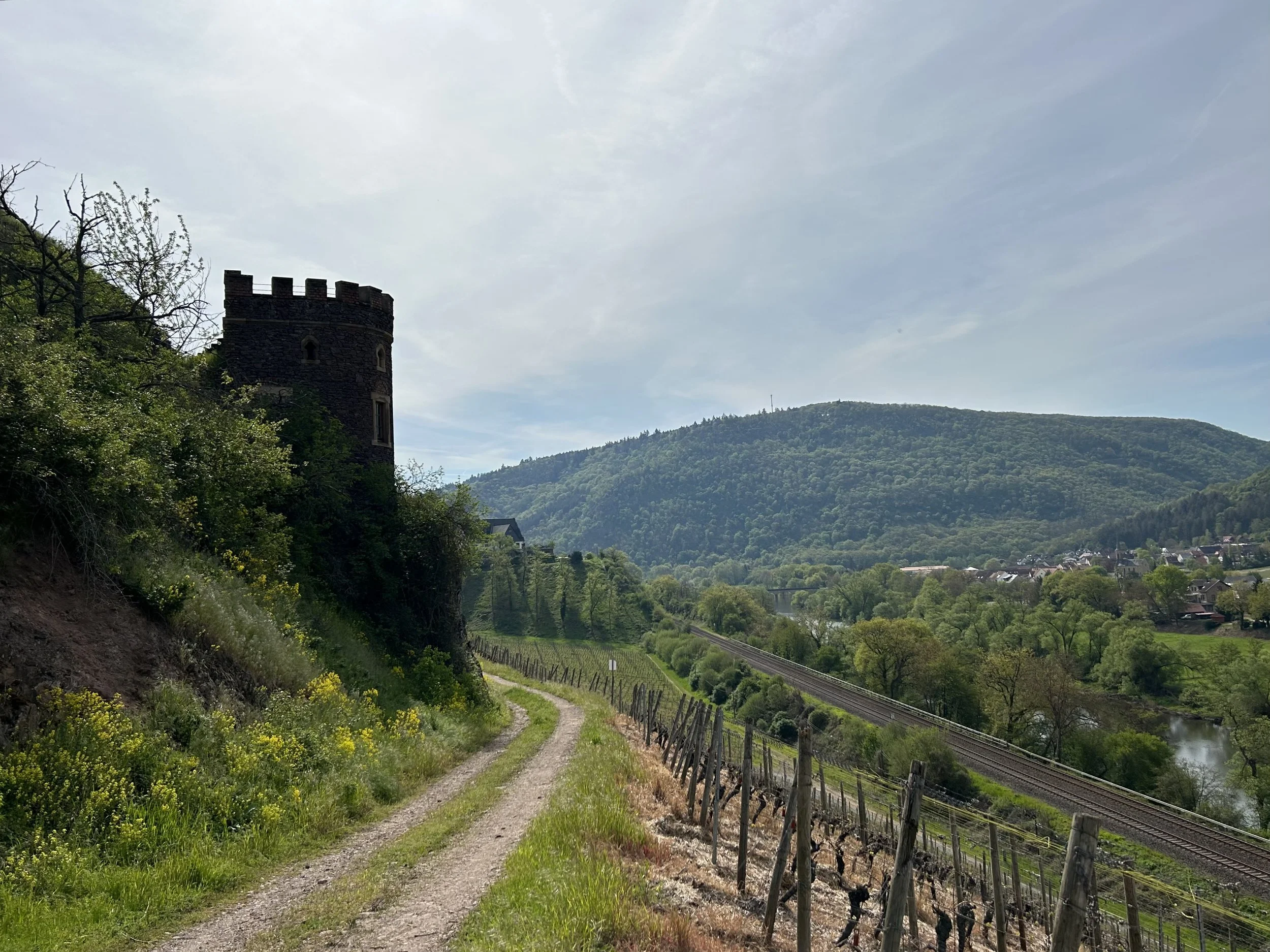
Schlossböckelheimer Felsenberg
In the late 2000s, Helmut's son, Cornelius, began working alongside his father and is now in charge of the family estate. If anything, the quality here has never been higher. Weingut Dönnhoff excels at both dry and fruity wines, with examples of the former often punishingly austere in their youth, and the latter regularly beginning their lives as demure examples of their respective categories—despite a consistently breathtaking sense of purity across the board. With time, the wines detonate into advanced tutorials on terroir. They’re excruciatingly delicious in their high-definition detail, and have no clear limit as to their capacity to age.
In April of 2024, the central Nahe suffered two evenings of merciless frost that Helmut described as unprecedented in his 50-plus year career. I happened to visit the day after the disaster when the vast scope of the damage seemed impossible to assess, as well as one year later when it had long been established that the estate had lost almost 80% of their 2024 crop. But the spring frost of 2024 was far from ubiquitous in Germany, and out of this catastrophe came something unusual, special, and exciting.
Weingut Wittmann in the Rheinhessen and Weingut Bürklin-Wolf in the Pfalz—both legends in their own right—each offered Dönnhoff a hectare of their own unscathed, estate-farmed vineyards to help make up for the losses to frost. In addition to this being a touching act of friendship, it presents a tantalising prospect for Riesling lovers. This is the wine equivalent to witnessing one of your favourite bands unexpectedly covering a song by another one of your favourite bands.
Dönnhoff is a Nahe master with a profound and articulate vinous signature, and to be able to taste their chilly, ethereal house style imprinted upon Rieslings grown in the limestone of Westhofen (southern Rheinhessen) and the sandstone of Wachenheim (central Pfalz) is great fun. But make no mistake… these might be one-offs but they're far from being novelties! The resulting wines are fascinating, thought-provoking, complex, and ravishingly tasty.
The Westhofen Riesling was farmed by Wittmann and the Wachenheimer by Bürklin-Wolf, but both were harvested by Dönnhoff's crew and fermented in 2400L doppelstück barrels in their winery. There’s also a Schlossbockelheim Riesling that you’ll read about below… The frost prevented Dönnhoff from making a Felsenberg GG in 2024 and the fruit that survived was declassified into a “village” wine to serve as a volcanic Nahe counterpart to the Rieslings from the Rheinhessen and the Pfalz. As a trifecta, these are enthralling, delicious and collectible testaments to friendship that will provide great drinking pleasure over the next 15 years or so.
Mix-and-Match 6 Bottles
of ANy Dönnhoff for 15% Off*
*Until End Of Business on Sunday 1 February
2024 Schlossbockelheimer Riesling Trocken $66
This is basically declassified Felsenberg GG, vividly boasting the site’s hypnotic smokiness, mysterious spice, and citric charm. Animated by mouthwatering acidity, the aromas and flavours are explicit like pan-toasted spices wafting through a Nordic wizard’s austere dwelling where obscure shrubs, diagonal luminescence, and herbal tinctures mitigate their pungency. An incalculably long finish unfurls like a blown out candle.
2024 Westhofener Riesling Trocken $66
Lemon balm, vetiver, and wintergreen combine in an icy sorbet that’s chalky for miles and at this young stage will challenge some Riesling lovers’ threshold for dryness—but most will rejoice in its talcy tension. It’s bright with rock juice and almost powdery in its racy, grippy textural detail and shimmering flavours. This, too, is kinetic with character, with a distinct and tantalising glacial charm akin to a Blanc de Blancs Champagne that was never destined to effervesce.
2024 Wachenheimer Riesling Trocken $66
Exotic without tropicality, rich threads of proud Pfalz apple and plum fruit are rendered gelid by Dönnhoff’s ornate, chiselled calligraphy. Broad-shouldered with palpable density, the acidity here is still electric but it caresses instead of pierces, and such dichotomy might make this the most interesting of the trio… but that’s a very tentative “might” as all three wines are hedonically fascinating. It’s arresting and delicious to recognise some of the central Pfalz’s hallmarks in a wine that’s also undeniably “Dönnhoff”.
Also available from Weingut Dönnhoff:
2023 Riesling Trocken $42
2023 Riesling Feinherb $41
2024 Riesling “Tonschiefer” $54
2023 Oberhäuser Leistenberg Kabinett $51
2023 Oberhäuser Brücke Spätlese $76
2023 Oberhäuser Brücke Auslese $76 (375 mL)
2023 Niederhäuser Hermannshöhle Spätlese MAGNUM $199
2020 Oberhäuser Brücke Eiswein $327 (375 mL)
Learn more about recent German vintages:
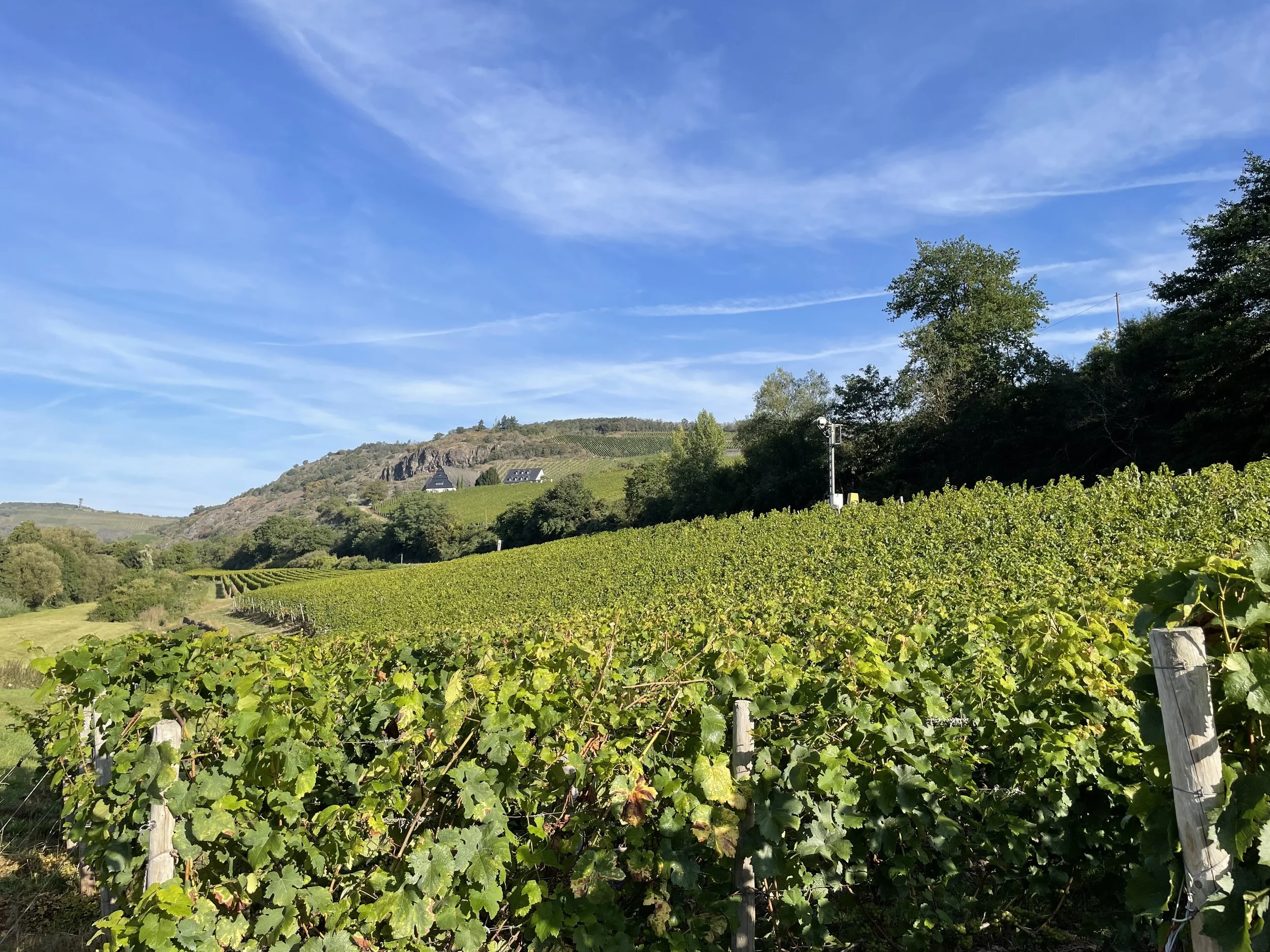
Oberhäuser Brücke
