
By Al drinkle
“I came home after
a day of mushroom hunting,
then the rain began”
- Matsuo Bashō
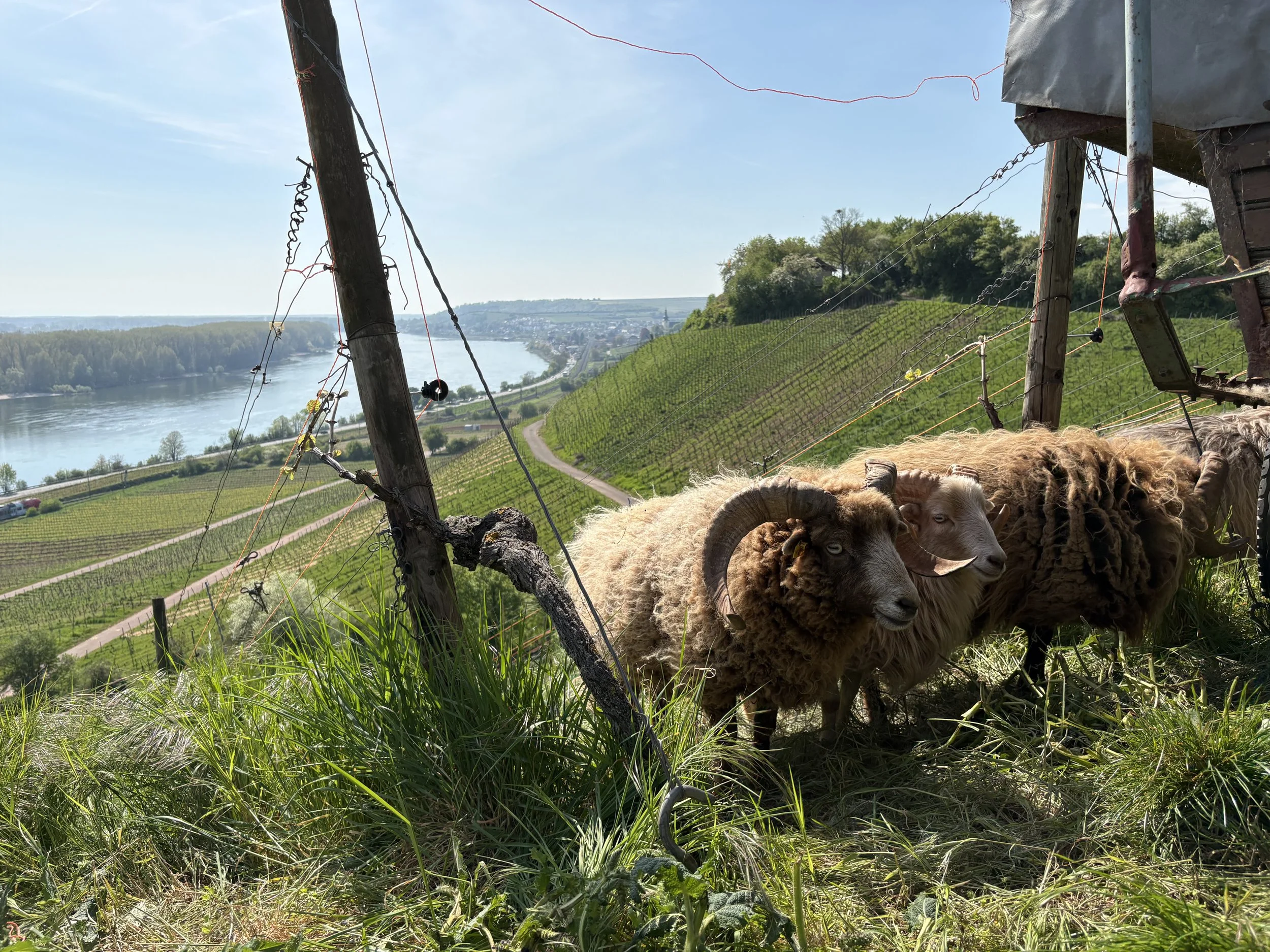
Niersteiner Pettenthal and the Schätzel sheep
I like to travel with a musical instrument, and few such contrivances are more portable than a harmonica. It especially pleases me to pack one that's German-made, granting it a temporary return to its country of origin. My Hohner “Marine Band" in the key of A sounds particularly mellifluous as I sit upon precipitous terraces or tranquil riversides, pitching its wistful tones out into the vines or waterways.
But it happens every time. As my luggage proceeds along the security belt, it's invariably diverted down the ramp for interrogation. The agent digs around a bit, eventually discovering the harmonica amongst my neatly folded undies and proceeds to quizzically remove it from its case. At some point I began separating it from my suitcase to avoid this annoying process, but they still send my bin down the naughty ramp on account of the mouth harp.
“Just a harmonica," the agent muttered to himself as I proceeded through security on this particular trip. “It looks like something else."
“What, exactly?" I asked, thinking this was my chance to solve a mystery of many years, inconsequential as it might be.
“Part of a gun," he replied with more than a hint of reprimand, as if the harmonica's coincidental resemblance to an unspecified portion of a firearm was cause for rebuke.
“Which part?" I queried further.
He paused before fixing his humourless eyes upon mine and almost whispered, “I don't know.”
“Next time I'll pack a kazoo instead."
I gathered my belongings, thinking that the agent should have been more pleased with the outcome. After all, the world needs more music and less weapons, just as it needs more compassion and less greed. And as people internationally drink less alcohol, the world also needs more authentic wine—liquids that are reverential to, and expressive of, the beautiful places that they grew—just as it needs less products that are expressive of nothing but corporate structures, industrial farming, and the flavour of factories.
About 10 hours later I was back in Germany. I travelled with a friend and customer this year—an amateur named Matt, but note that Webster's defines that as someone who engages in a pursuit, study, science, or sport as a pastime rather than as a profession. Though Matt doesn't work in the wine industry, his grasp of the subject would be the envy of many “professionals.”
While visiting Weingut am Schlipf in Weil am Rhein—the southwesternmost outpost of Baden, bordering both Switzerland and France—Matt noticed a basket filled with adorable wooden mushrooms in the winery. As corks went flying at a restaurant later that evening, we asked Schlipf co-proprietors Christoph and Johannes Schneider about the mushrooms and were told that they had been lovingly crafted by their elderly grandfather. He himself had been a winegrower and barrelmaker in Weil for many decades, and perhaps artfully lathing these mushrooms keeps him connected to the land that he loves so much.
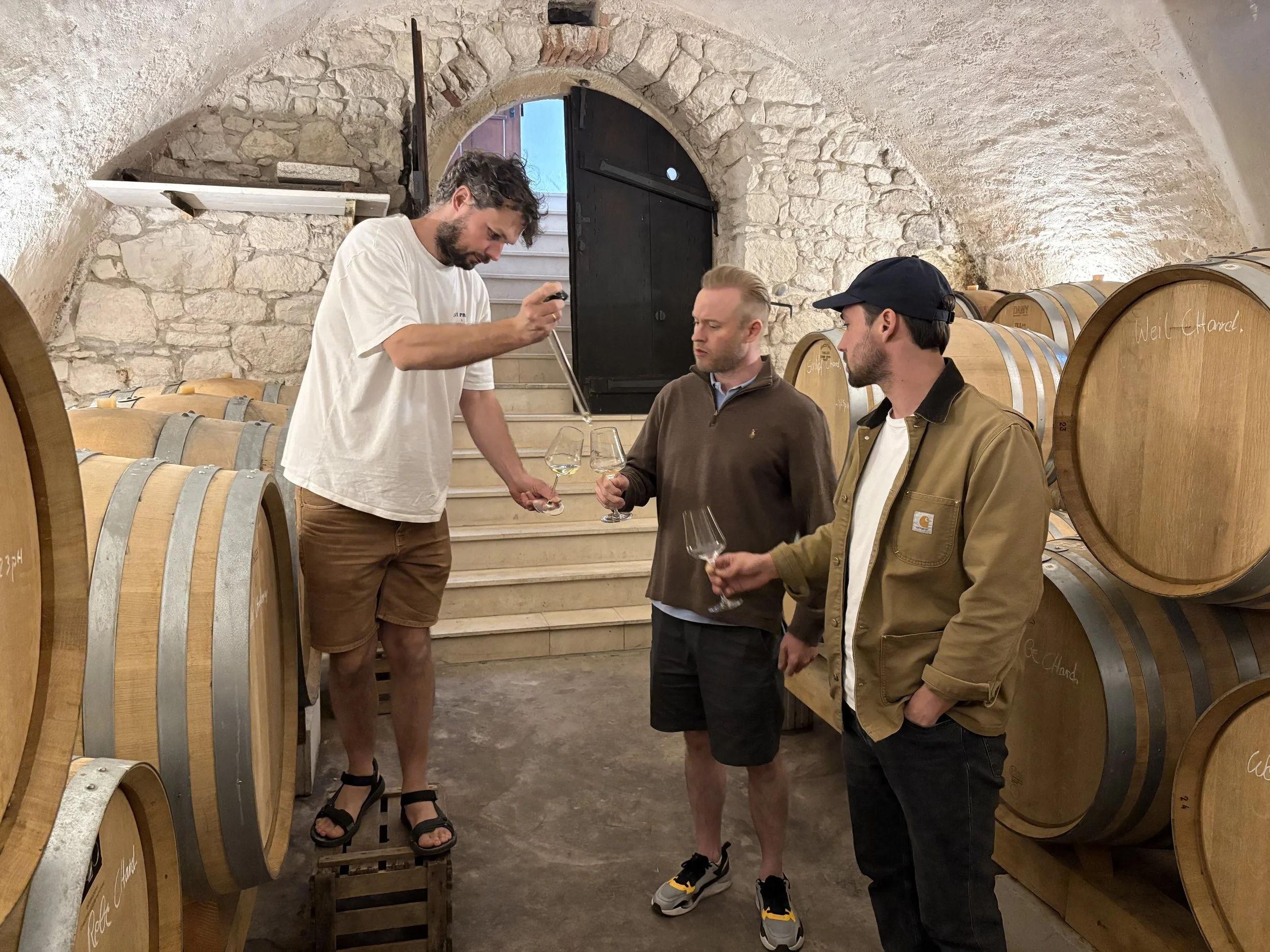
Matt (centre) with Johannes and Christoph Schneider
The next morning, Matt and I were standing by our rental car in front of a tiny, characterful hotel where far too little sleep had been achieved. We were moments away from heading to the Mosel, letting the warm Baden sun splash upon our faces prior to the long drive. Suddenly, Christoph Schneider swerved towards us in his car, momentarily blocking traffic in order to hand us each a stubby little wooden mushroom through his passenger window. Thirty seconds later he would have missed us.
My visits with winegrowers have now been completed and I've stayed on in the Mosel to compose this report on the 2025 Riesling vintage—yet another year where the character of the wines delightfully belie the details of a growing season not without its challenges. The river flows under the window of where I'm writing and a stubby little wooden mushroom sits amidst Riesling bottles on the makeshift desk, somehow galvanising my focus by embodying harmony, compassion, kindness, community, friendship, and hope—all of which are essential but often-uncited ingredients in wines worth drinking and writing about.
The 2025 Growing Season - Time Bomb
The short story of German Riesling in 2025 is that summertime optimism for the greatest confluence of high quality and high volume in at least a decade was literally washed away with excessive rainfall at harvest time. The full story is, of course, more nuanced and complicated.
The winter that bridged 2024 and 2025 was mild and wet, giving the vines ample hydric support to begin the growing season. Then favourable weather conditions in early spring catalysed a vegetative cycle that was only slightly behind 2024 in timing. There was a fear of the recurrence of frost, but mercifully it didn't materialise in 2025. Excellent weather continued, including during flowering, setting a large crop of fruit that would prove to be critical by the end of the season.
Common to all Riesling regions, warmth and sunshine throughout late spring and summer were peppered with intermittent rain showers, so drought stress wasn't an issue¹. Furthermore, there were no reports of hail, disease pressure, insect blight, or any other malediction upon the vineyards during the majority of the growing season.
Countless growers reported to me that everything looked absolutely perfect as late as mid-August, though it was already clear that it would be an early harvest. The paucity of critical vineyard work at this point allowed producers to prepare their cellars for the busiest time of year, though there wasn't yet any way of knowing quite how hectic the coming weeks would prove to be.
It seems that every vintage is record-setting in some way these days, and 2025 is no exception. High must weights, stable and ripe acidity, and sufficient physiological ripeness coincided to make this the earliest start to harvest ever for the majority of the growers with whom I met. Additionally, a significant change in the weather would also make it the fastest, most compact harvest that most had ever conducted. Many producers had already collected fruit for their entry-level Rieslings before the rain came, but when it arrived, the story of 2025 shifted dramatically.
Just before the finish line, the storybook growing season became a ticking timebomb for Germany's Riesling producers. Oliver Müller of Weingut Wagner-Stempel (Siefersheim, Rheinhessen) claims that there was “rainfall of biblical proportions” by the third week of September, and in tandem with moderate temperatures and high must weights, the precipitation instigated the small and concentrated Riesling berries to burst upon the vine, causing rampant botrytis² to spread throughout the vineyards.
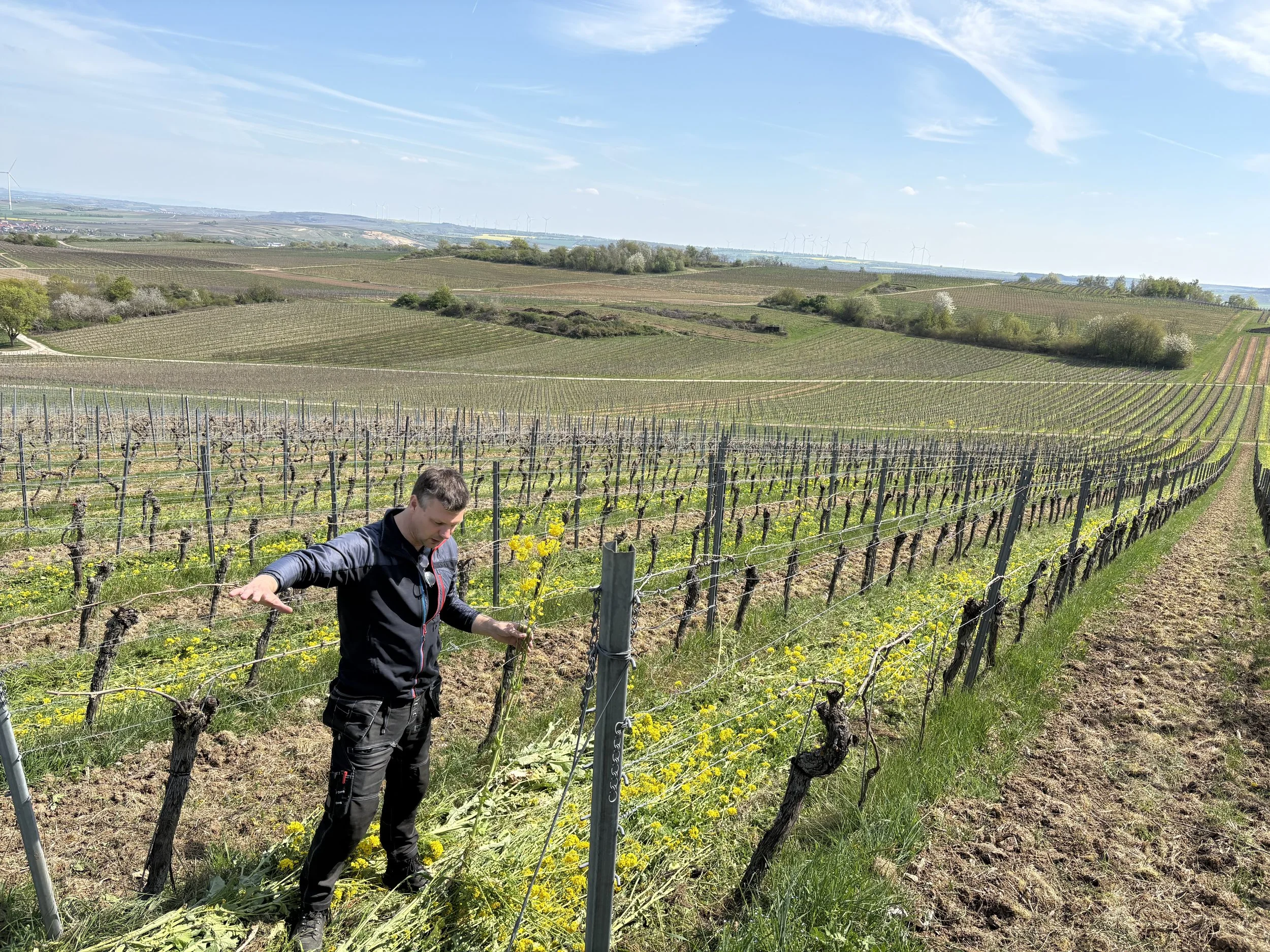
Oliver Müller of Wagner-Stempel
Harvest immediately went into turbo mode and in the pursuit of quality, teams had to work exhaustively. Sascha Schömel of Weingut Dönnhoff (Oberhausen, Nahe) noted a ripening curve of “ripe… riper… VINEGAR!” if one delayed, and indeed, multiple producers shared with me that some of their less propitious sites were decimated by rot before they managed to harvest them.
Not to understate the challenges for Riesling growers throughout the country in 2025, it's worth noting that in addition to the grape systematically ripening later in the Mosel than it does along the Rhein, the rains also arrived a bit earlier here. Andreas Adam of Weingut A.J. Adam (Dhron, Mosel) shared that “what looked like it would be a repeat of 2015 ended up feeling like the nightmare of 2014 as harvest got underway.”
Grapes for dry wines, especially from top vineyards, were prioritised, and estates as stylistically diverse as Dönnhoff in the Nahe and Weiser-Künstler at the corridor of the “Terrassen” Mosel conducted the harvest of their most prestigious dry wines and an inordinate variety of Auslesen simultaneously—often with the same cluster of grapes providing ingredients for both styles! However, it was an exceedingly rare luxury that everything harvested from a particular site was useful for high-end, albeit divergent, wine styles.
Common to all Riesling regions, a significant amount of the work that went into the 2025 harvest involved the painstaking sorting of healthy grapes from those affected by rot, and the job got harder as time progressed. The quicker one worked, the more meticulous their selection, and the more willing they were to sacrifice subpar raw materials, the better chance they had of making good wine. It was helpful that 2025 began with ample quantities on the vine, as the pursuit of top quality involved a militant triage.
And then, all of a sudden it was done. “It was the craziest harvest ever,” shared Alexander Schregel who farms his own eponymous 5-hectare estate while serving as the vineyard manager for Weingut Leitz (both Rüdesheim, Rheingau). “It was finished at the time when the average harvest is just beginning.” To this I would add a wistful observation made by Matthias Kerpen (Wehlen, Mosel) who noted, “each year it seems that the optimum time for harvesting is getting shorter and shorter.” He also shared that this was the first leisurely October that he's ever enjoyed in his life, as the previous 30 or so have been spent working harvest.
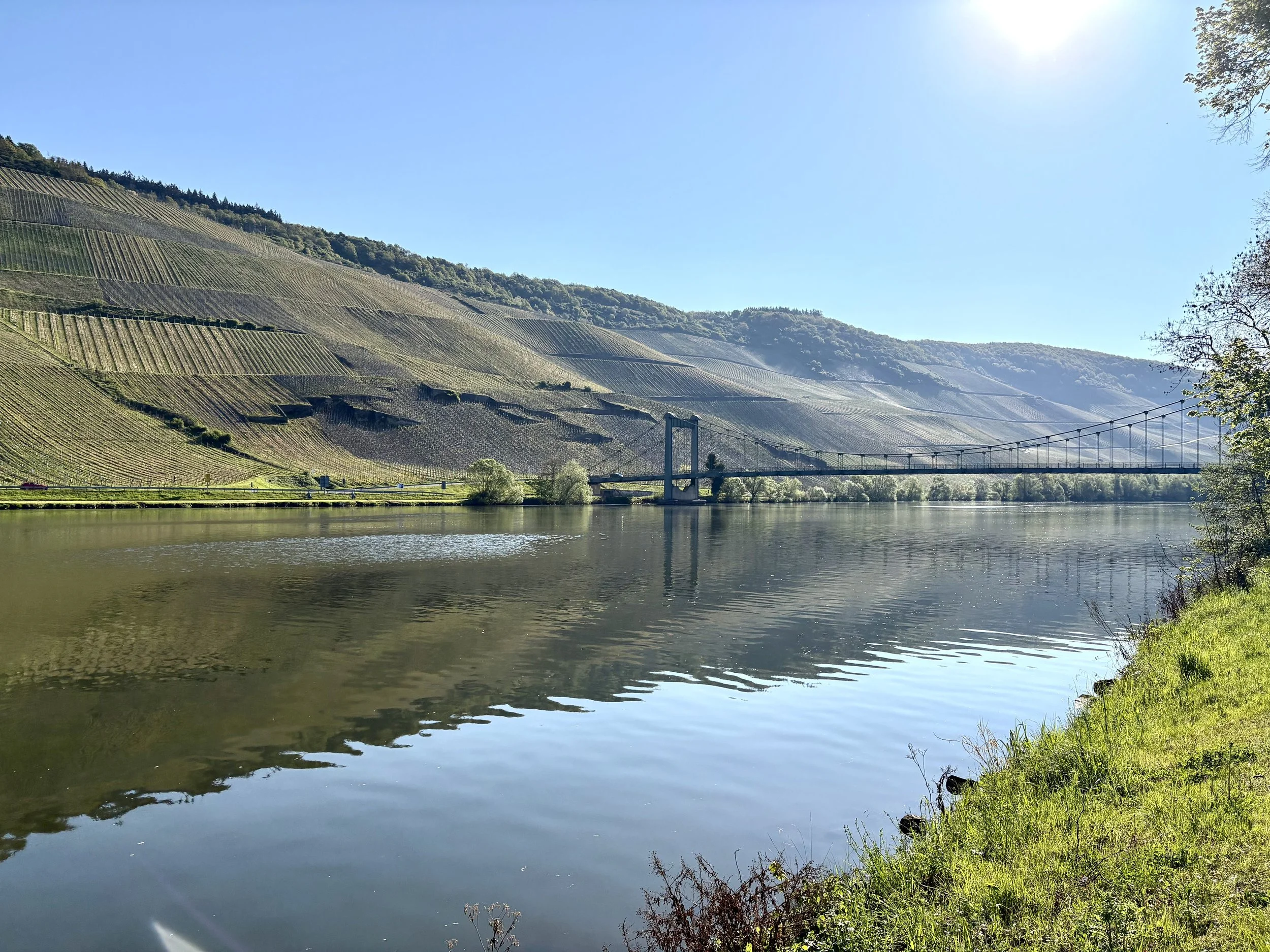
Wehlener Sonnenuhr
There's much food for thought here, not the least of which is the significant advantage of being a small operator in a vintage like 2025. It goes without saying that when the pressure is on, it's easier for a five or six-hectare estate to strategise their harvest than it is for one that's 10 times that size or more. Even if you allow that the bigger players would inevitably have more robust harvest teams, successfully mobilising everybody to be at the right place at the right time would certainly have its challenges.
It might also depend on the terrain that one is farming, as well as how close one's vineyards are to their cellar. Collecting fruit from steep slopes obviously presents a bigger challenge than harvesting flatter vineyards, and as growers shared their strategies with me, I couldn't help thinking about the fact that a few high-profile Mosel and Saar producers have grown to over 100 hectares spanning half the Mosel valley. It's hard to imagine that such estates could make uniformly good wine in 2025. Luck and friendship can also come in handy—Leitz in the Rheingau finished harvesting so early in 2025 that several members of their seasonal team were able to cross the Rhein to help Dönnhoff in the Nahe work against the rain.
The discussion of machine harvesting came up a couple of times, which is a pursuit that I often find myself defending in a world of escalating prices. It's clear that the machine can't be as decisive as a skilled human, but it's an increasingly important tool if we want to sell wine from independent producers farming their own vineyards for less than $30 CAD. However, I was surprised that a small number of elite growers—the kind who typically take hand-harvesting for granted—shared with me that, given how a harvesting machine can work with incomparable rapidity, it was key to their success in 2025.
Perhaps Matthias Meierer of Weingut Meierer (Kesten, Mosel) put it the most succinctly in saying, “it's easy to be judgmental, but who can deny that when a deluge is on the horizon, it's better to harvest healthy fruit with a machine than to harvest rotten fruit by hand.” For the record, Meierer borrows a machine harvester to collect Riesling from flat slopes destined for his Litre bottling, but the majority of his seven hectares are on steep slopes and are harvested by hand. This all being said, technology is advancing rapidly, and harvesting machines now exist that can collect fruit from vertiginous vineyards where handwork was previously the only option. Meierer revealed that a company near his village rents out four such machines, and that they were in particularly high demand in 2025.
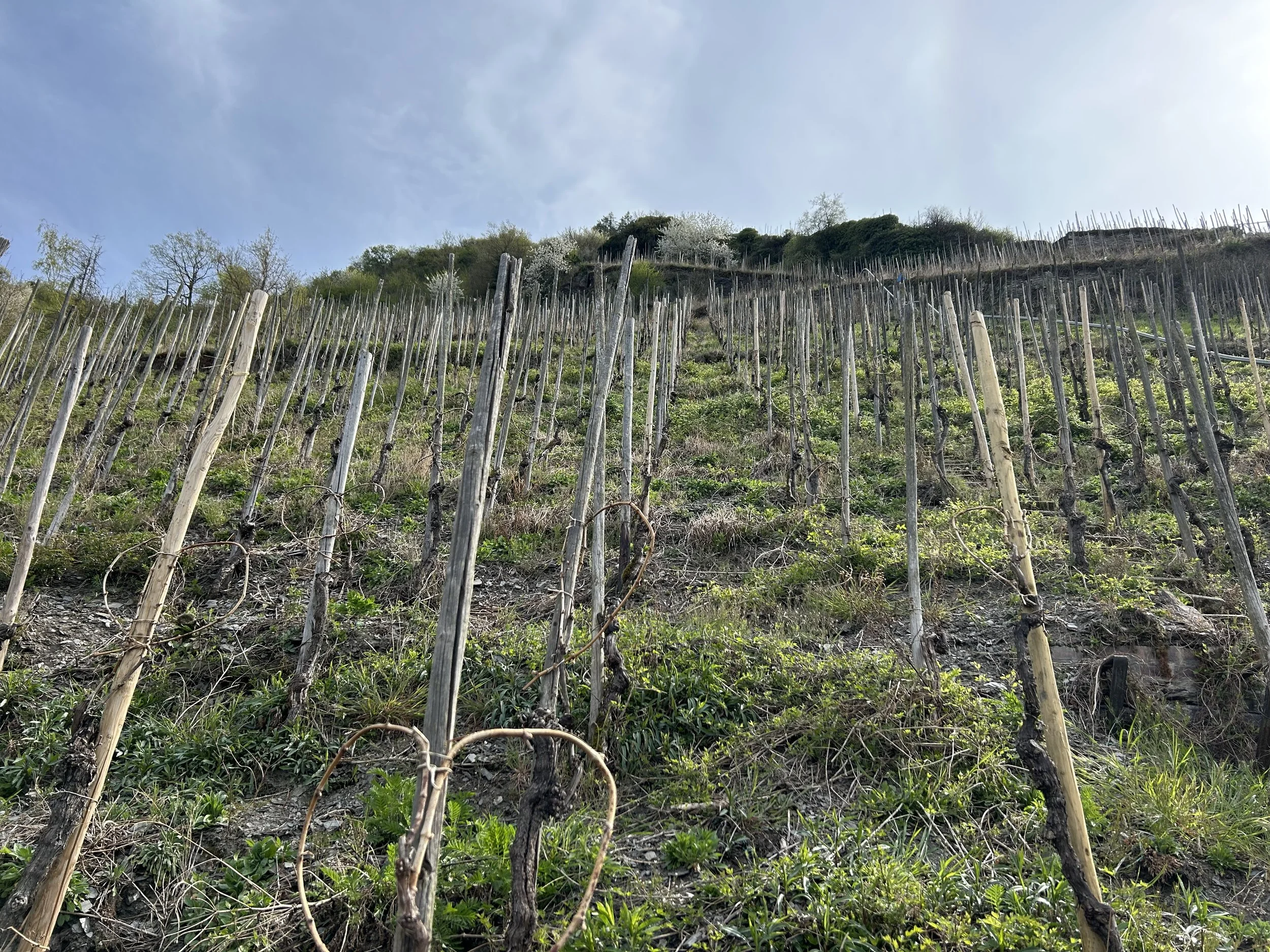
Enkircher Ellergrub
2025 German Riesling - Concentrated Animation
The 2025 German Rieslings are fucking loaded. They are high in both ripeness and acidity, with decent extract levels that combine to give them a palpable sense of midpalate density. They are solid, powerful, and strapping, boasting tensile, crunchy structures and tantalisingly obdurate finishes. In short, they have great concentration coupled with sizzling animation. In their extreme youth, the '25ers are shiny and brassy but harmonic, like a smokin’ horn section. This is starting to sound like they lack elegance, which isn't the case, but they tend towards an athletic refinement as opposed to any sense of delicacy—they simply have too much torque to be daintily graceful.
As my recap of the growing season indicates, there was certainly a lot that could go wrong, but I only caught minor glimpses of this.³ With the threat of rain, some wines were harvested a bit too early, thus compromising their physiological ripeness and rendering them somewhat snarly. Others on the dry side show an unwelcome funkiness—botrytic or otherwise—indicating less than meticulous sorting. Some Rieslings just taste neutered, for which I might be justified in blaming an attempt at using cellar trickery to combat the aforementioned maladies or others—the wines thereby rendered banal instead of offensive.
I was worried that the 2025 Rieslings might be somewhat compromised aromatically given their shorter than usual hangtime. Happily, this concern was unwarranted as there's a gorgeous aromatic amplitude that transcends region and style. One might expect a frequent occurrence of pomaceous fruit given the warm summer, and one would find it, often along the lines of Bosc pear, Jonagold apple, and ravishing peach. But that's not to say that the vintage is without cooler, more herbaceous or minty threads of scent—especially within the Nahe and the Mosel.
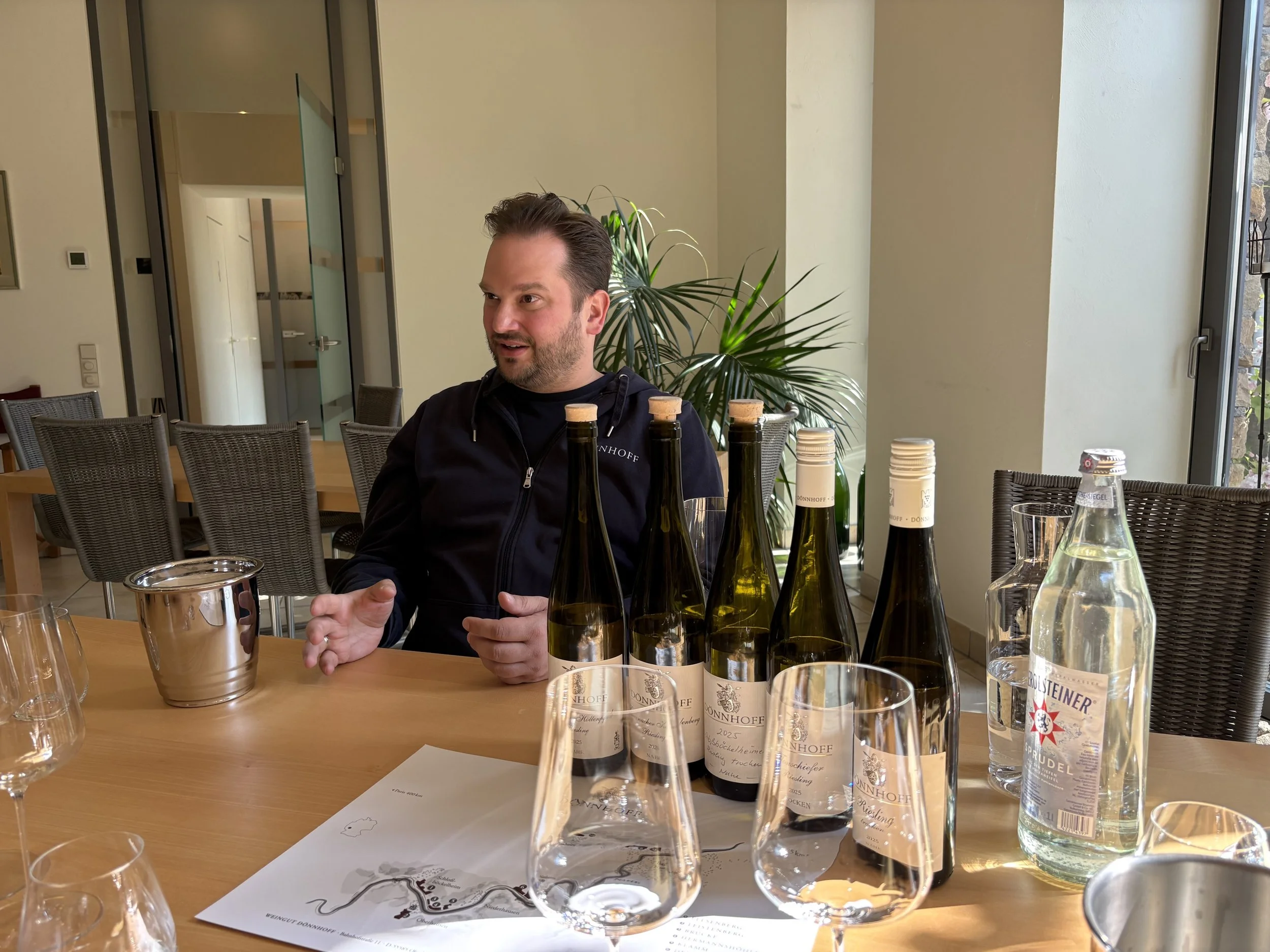
Sascha Schömel of Weingut Dönnhoff
A frequent note that I made was “candied blossom”, and I wish I had a more articulate way of putting this. I'm referring to a motif of alluring, brittle florality that seems to foreshadow sweetness in the wine—despite how erroneous that implication might be. Of course this, like most youthful Riesling aromas, is ephemeral, but it certainly reinforces the compelling immediacy of many of the wines.
In terms of both aromas and flavours, the vintage also has an interesting exotic side, but this shouldn't be misconstrued as tropical which the '25s almost never are. Instead, I found that there's a flashy citric charm to many of the wines—think oranges and their blossoms, grapefruit in the most awakening sense, or a mojito that outstrips the capacity of your favourite celebrity bartender. I also made more references to red berries—strawberries, cherries, and blackcurrant, for example—than any other young Riesling vintage that I've tasted.
Amidst this immense range of appealing aromas and flavours, not to mention the substance and eloquent complexity with which they're communicated, I seldom found that I was noting stoney or mineral markers—except for a few earlier-harvested Mosel wines that charmingly betray their origins of slate. The wines are still crunchy, explicit, salty, and all that, but they're much more allied with fruit than they are with rocks.
The ripeness of the vintage tended to result in slightly higher alcohol levels in the dry wines and slightly more residual sugar in the fruity ones. This, along with almost everything else, stands in glaring contrast to 2024, especially when I was shown a few GGs that hover around or northwards of 13.5% alcohol. Stealthily carrying higher levels of alcohol doesn't tend to be one of German Riesling's myriad virtues, but most of the '25s that attempt this are so extroverted in flavour that their higher octane seems not to show at the moment, except perhaps to pad their shoulders even further. Similarly, there's a recurrence of taut juiciness among many of the fruity styles which doesn't make them unattractive—it's just a deviation from the prädikatsweine of 2021, 2024, and to a lesser extent, 2022.
In general, true, light Kabinett was a difficult achievement in 2025. Difficult, yes, but certainly not impossible. In the recent past, vintages like 2025 might have engendered a distinct paucity of genuine Kabinett, but the difference is that growers and partisans alike have a very different attitude towards Kabi than most did a decade or two ago. We fucking love it now, and it's become a style that's actively pursued and frequently achieved. Among Metrovino's winegrowing partners, Schätzel is 2025's primary Kabinett crusader outside of the Mosel valley (they've got five tantalising versions in 2025), with A.J. Adam and Hofgut Falkenstein being the consummate masters within it. All of their 2025 renditions—not to mention cuvées from many other growers—will more than satisfy the purists, among whom I proudly stand.
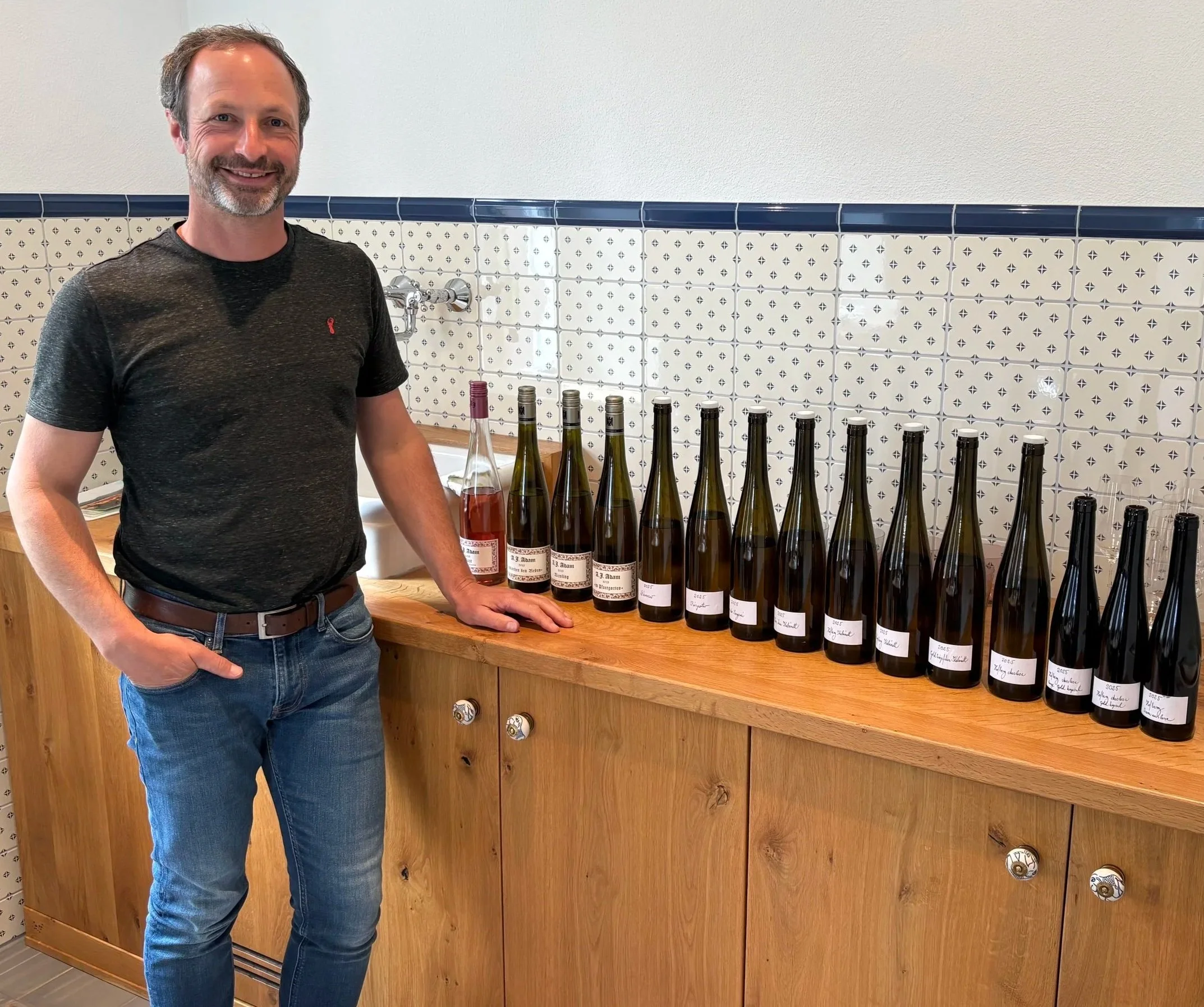
Andreas Adam
On paper it seems like 2025 would be a good year for Spätlese, what with all that botrytis attacking ripe Riesling grapes. I suspect that it could have been, in fact, and I certainly tasted some excellent examples across almost all the regions that focus on the grape. The problem was that the harvest was so stressfully expedited that growers had to focus on a category far more crucial to their portfolios—namely, dry wines. Had 2025 happened 20 years ago, it might have been a Spätlese vintage for the ages. As it was, relatively small quantities of top-tier Spätlese were produced, but most growers chose to instead pursue often excellent, strapping dry wines as well as a delicious and welcome byproduct…
Auslese. I know, you don't care and you don't want to hear about it. Who needs it? What the hell are you even supposed to do with it? The previous four years haven't been conducive to Auslese in anything more than nominal quantities, but partly due to the surgical isolation of healthy botrytis to make clean dry wines, and partly due to the general abundance of rot (some of which was noble), there's a spoil of riches in 2025. The best Auslesen of this vintage are extraordinary, uncanny statements of terroir, presented through a high-fructose lens. I'll be ordering a wide range of my favourites which will make for the most ridiculous selection that Metrovino has ever offered. My instructions as to what to do with them can be found here.
In much smaller quantities, 2025 also provided a short window wherein grapes of even higher ripeness levels could be collected for botrytised dessert wines, but most of these were difficult to assess at this infantile stage of development. The best seem poised to become tantalising elixirs for your children or grandchildren to enjoy in their retirement.
Given that the GG category (and equivalents, depending on the producer) indicates a somewhat over the top style to begin with, the 2025 versions are often creatures of bombast. With high ripeness, intense acidity, undue power, and merciless concentration, they’re impressive and they'll garner high scores and florid tasting notes from those who participate in such journalistic circle jerks. Some of them are also eminently beautiful and emotionally stirring, but across the board they're going to need some time to settle down.
Varying from region to region, producer to producer, and dependent upon a winery's membership in any number of grower alliances (the most visible being the VDP), the “premier crus” or “village wines” from 2025 offer tremendous rewards and are usually more delicious than their GG counterparts. Whether dry or feinherb, such wines embody the concentration, complexity, and stamina inherent to the vintage without redlining with exuberance. I recognise that this is a complicated and amorphous “category”, but every single Riesling producer that we work with made at least a couple of excellent village blends or second-tier single-site wines in 2025 that are eminently worthy of a place at your table and in your cellar.
Finally, but most crucially, good growers made phenomenal estate wines in 2025. These were generally collected before the rains began and will offer significantly more sunshine and flesh than their 2024 counterparts, not to mention the fact that they will almost always be more appealing to people who aren't Riesling nerds (ie. people who would rather cut their hair with a weedwhacker than read this article). The vintage offers an abundance of vivid, electric, singular Rieslings that restaurants will be able to afford to pour by the glass, and that people of modest means can guzzle with reckless abandon on a regular basis.
A Look Back at 2024
I can't help thinking that a lot of the reporting on 2024 was disingenuous—even when the authors didn't have to sell the wines. (Although everyone's selling something, and sometimes it's a story that will ensure their return invitation to high-profile tasting rooms next year). Sure, a cool vintage with classic wines that epitomise the singularity of German Riesling is exciting for traditionalists like myself, but that doesn't mean that the occurrence of such a vintage automatically makes it good or great.
I stand behind everything that I said about the 2024 Rieslings, both the good and the bad. The wines are chaotically inconsistent, though the highs can be supernal. While one could say that the goal of our buying decisions is to make the vintage look as good as possible to the Alberta market, this is actually just a byproduct of our true directive—namely, to offer our customers the best Rieslings that we can from each respective vintage. As I wrote last year, buying the 2019s “blind” when the pandemic impeded our travels turned out alright. Doing so with the release of the '24s would have resulted in many abject disappointments.
When poured next to their 2025 counterparts, the Rieslings that I like from 2024 don't necessarily pale in comparison—they’re usually so stylistically divergent that one's mind doesn't default to thinking along the lines of better or worse. None of the '24s that I've engaged with seem to be showing signs of developing much TDN, and I suspect that this won't ever be a significant or prolonged phase of the vintage's development. I consider this a good thing, and in general I'm grateful for the best Rieslings that 2024 provided us with.
The bottom line is that 2024 was an extremely challenging and largely pretty shitty German Riesling vintage where some really good, singularly light and intense wines were sporadically made by excellent growers. I stand in stark disagreement with anybody who said otherwise.
What Else is Going On in Germany?
To put it bluntly, far too much to write about here. This report is already excessively bloated so we'll inundate your inbox with specific articles on other exciting topics in the coming months. But there's so much going on…
For more reading: Calgary, Meet Spätburgunder, Pop Goes The Griesel, German Sauvignon Blanc WTF?!
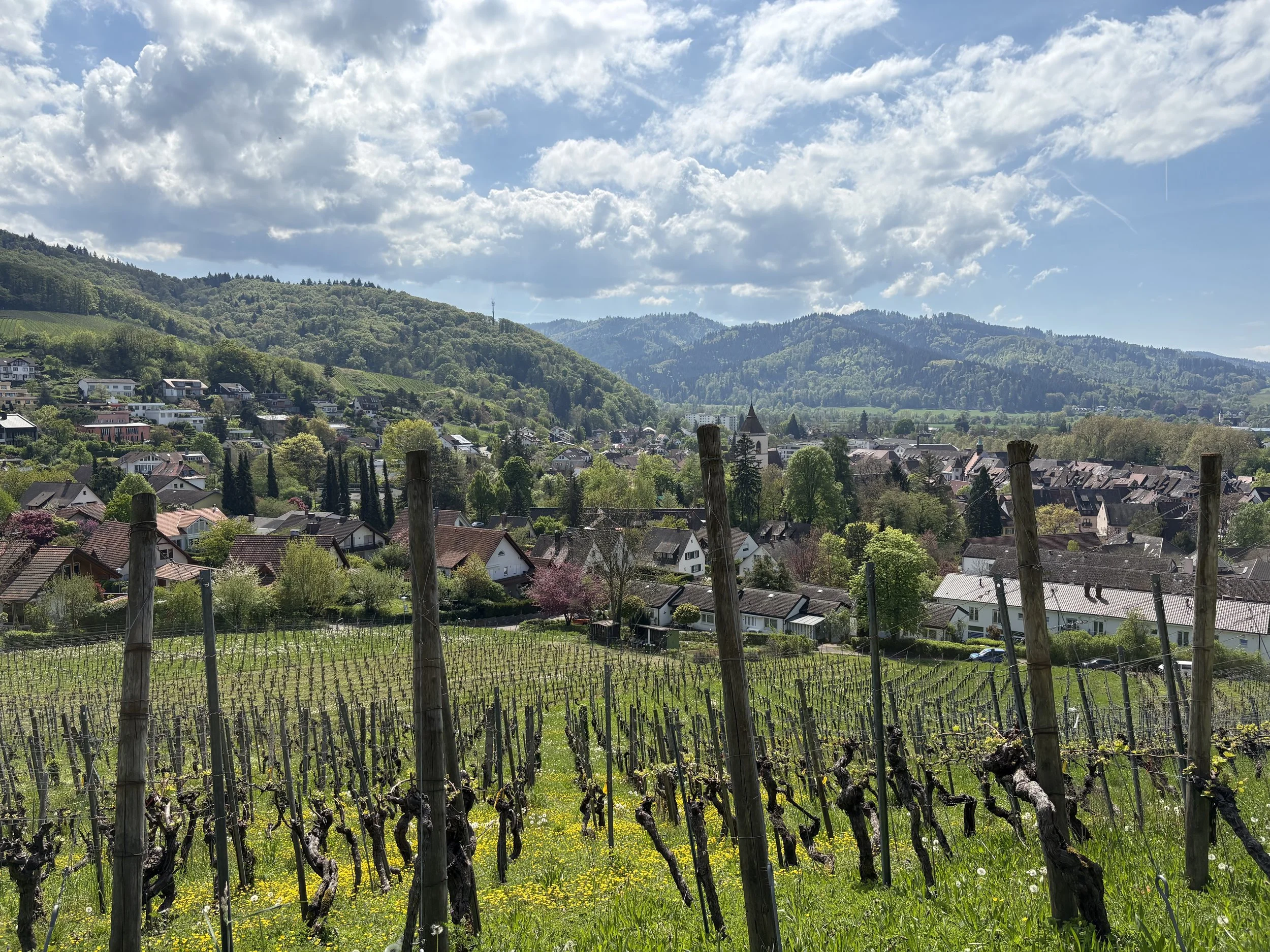
Staufen im Breisgau, Baden
German Riesling in the Marketplace
None of the German growers that we work with raised their prices this year—and only one or two had made minor adjustments last year to cover stratospheric losses to frost. This is incredibly generous and helps significantly with final prices here in Canada where the Euro is pummeling the CAD. However, most of our collective necessities and frivolities haven't increased in price because the producers, manufacturers, farmers, distributors, artists, or merchants are lining their pockets. The costs are disappearing into inflation, taxes (including tariffs), currency exchange, and transit costs. Bickering politicians and their wars aren't helping, although I'm ecstatic that the Alberta government has rescinded the absurd ad valorem tax on wine that they had implemented in April of 2025. Were it still nefariously amplifying the challenges of fuel prices and currency exchange, I really don't think that the authentic wine scene would have survived for long in Alberta.
Along with my colleagues at Metrovino, I've fought hard for the virtues of German Riesling over many years, arguing that no other wines offer the same confluence of value, deliciousness, terroir transparency, and aging capacity. People began to catch on and we were able to sign more and more producers, committing to greater swaths of their (frequently expansive) portfolios. It even got to the point where I felt like the momentum that we had accumulated might be signalling a shift in the general consensus. I never wanted Riesling to be a trend, of course, nor am I naive enough to expect that it would resonate with the masses. I just thought that German Riesling would find its place among the classics that people with good taste would instinctively gravitate towards.
I've since learned that the fight for German Riesling must continue, even if it requires that every waking hour of my existence be devoted towards the promotion of the world's greatest white wines. There's still far too many wine professionals who view it as a novelty, or too many who claim to harbour sincere respect for it but curiously never drink it. Even among the undisputed devotees, not enough of us view German Riesling as having the credibility to bring to those fancypants wine events where Instagramability is more important than the stirring of souls.
Germany is not an inexpensive country in which to produce wine. It's true that it's been regarded as such for a long time, but this is partly due to generations that were willing to do the work for a pittance, and partly because for several decades, German wine was so patently and globally unfashionable that the pricing of the wines couldn't be anything but low. These two issues are merely bifurcated nuances of the same problem. Recent generations have been largely uninterested in winegrowing, and those that embrace it these days are almost invariably formally-trained, well-travelled, and are following this lunatic destiny with the intention of producing the very best wine that they're capable of—and they don't want to do it for free.
Of all the issues impacting the cost of wine, vintners seeking a fair compensation for their hard work is the one that simply cannot be criticised. But with the exception of a handful of exclusive producers, even the summits of most German grower's portfolios are financially obtainable by virtually all wine lovers. It goes without saying that this makes German Riesling more approachable than any of the other classic wine categories of the world, and it's a grave mistake to take this for granted.
If you have to make compromises as to which wines to buy, or if you notice that your budget provides you with less bottles than it did in the past, please keep in mind that this has nothing to do with the German growers themselves, nor is it reflective of a greedy tactical move on the part of Metrovino. I hope with all my heart that when financial sacrifices have to be made, German Riesling is recognised as the essential, life-affirming serum that it is, and that the heroic growers get the support they need to continue to do their valiant work.
Piesport, April 2026
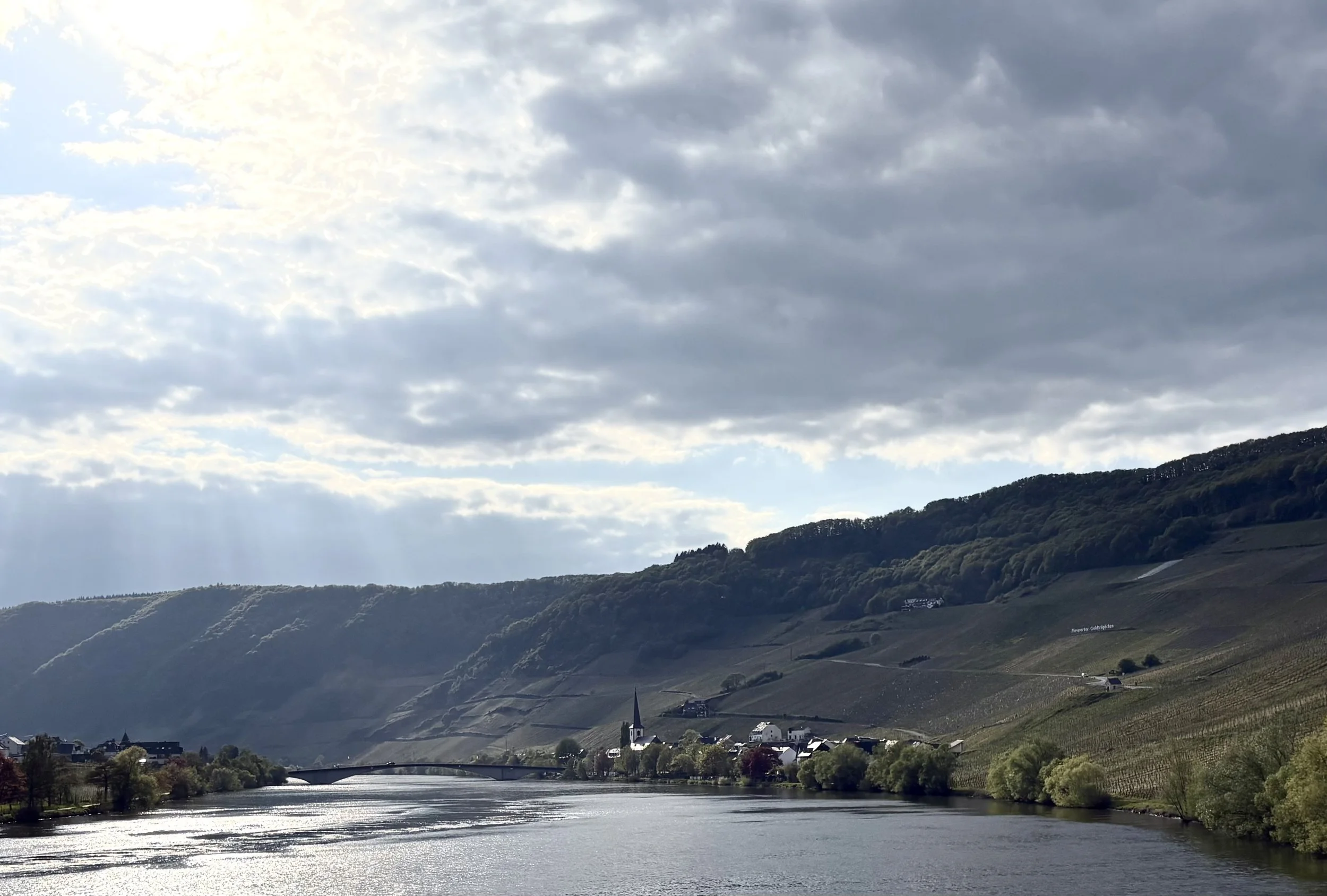
Piesport
