
By al drinkle
Though the door is never closed, we definitely weren't seeking another Riesling producer. (We're always in search of new Riesling drinkers, however, so read on for compelling reasons to become one). You can therefore be confident that Alexander Schregel's wines are here for at least two salient reasons. The first is that they’re stylistically divergent enough from those of our other Riesling growers to justify their integration into our portfolio. The second is that I'm so excited about these wines, it was imperative that I created a situation whereby I could spontaneously drink them whenever I wanted. A byproduct of the second point is what I feel to be an intrinsic responsibility to share them with as many people as possible.
An exceedingly affable and composed guy, Alex is a native Rheingauer who was quite literally raised on Riesling. He comes from a family of vintners (his father being the technical director of Weingut Künstler in Hochheim), and prior to reaching the age of 30 he was appointed vineyard manager of Weingut Leitz's 130 or so hectares of vines. This remains Alex's full time job and he’s presently ushering Leitz and their vast vineyard holdings towards official organic certification.
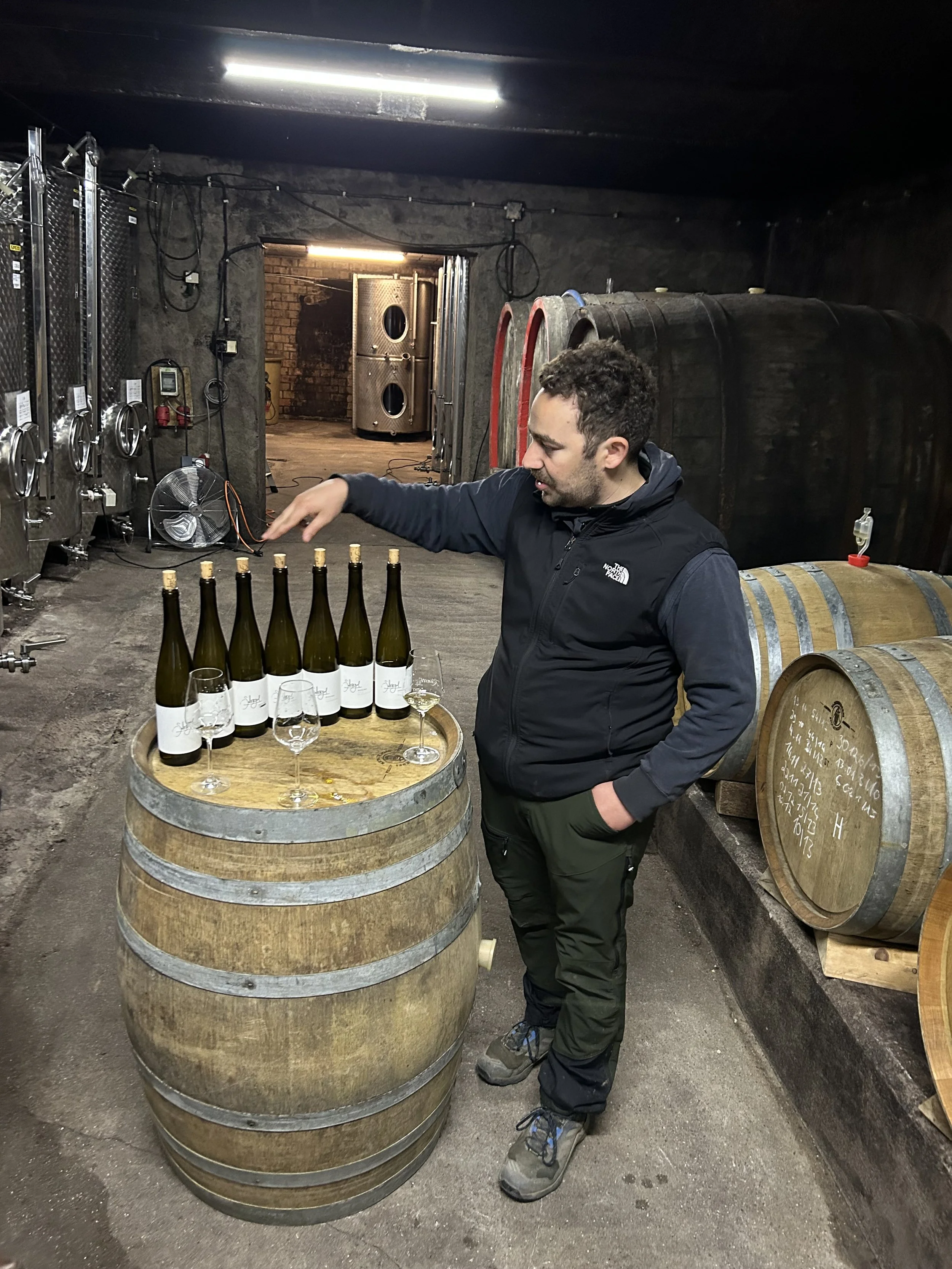
Alexander Schregel
I met Alex via Johannes Leitz some years ago, and I vividly recall that in September 2021—despite him being on crutches for an injury that now eludes my memory—he ushered me through a highly educational vineyard tour of the western Rheingau. I'm not audacious enough to think that I'm ever beyond learning, but let's just say that this wasn't my first rodeo and I was blown away by the young man's inherent intimacy with the region, not to mention our shared conviction of its potential for greatness.
On holiday in the summer of 2024, I was swaying by the sidelines of an interminable conga line at Johannes Leitz's 60th birthday party. The sips were flowing and the sips were good. All of a sudden, Alex was at my side with his warm smile. I hadn't seen him for a couple of years and as the party erupted to the infectious pulses of “99 Luftballons”, we exchanged pleasantries before he yelled in my ear that he had established his own winery on the side.
To understand my enthusiasm at hearing this news, something must be said about the tiny but mighty Rheingau region. It's the most Riesling-centric agricultural district on the planet, but somehow also the least progressive region in Germany—as if most of its winegrowers feel that their collective vinous achievements of the past couple of centuries were substantial enough to justify lackadaisical efforts in the present day. Of course there's a few producers who make great Rheingau wine every year and we proudly work with some of them, but there's less than one would hope considering the illustrious potential of the land, and I was unaware of any fledgling producers of note. As my wife dragged me onto the dancefloor, I told Alex that I'd be in touch when I returned for business.
Weingut Schregel presently consists of 4.5 organically-farmed hectares, concentrated in the villages of Rüdesheim, Lorch, and Hallgarten. Arriving for my first visit to Alex's cellar, and knowing that he’s more than capable of holistically farming for excellent raw materials, I expected the wines to be good. What I couldn’t have anticipated was that the estimable quality would be allied with a decidedly anachronistic approach to winemaking, resulting in wines of stunningly singular flavours and textures.
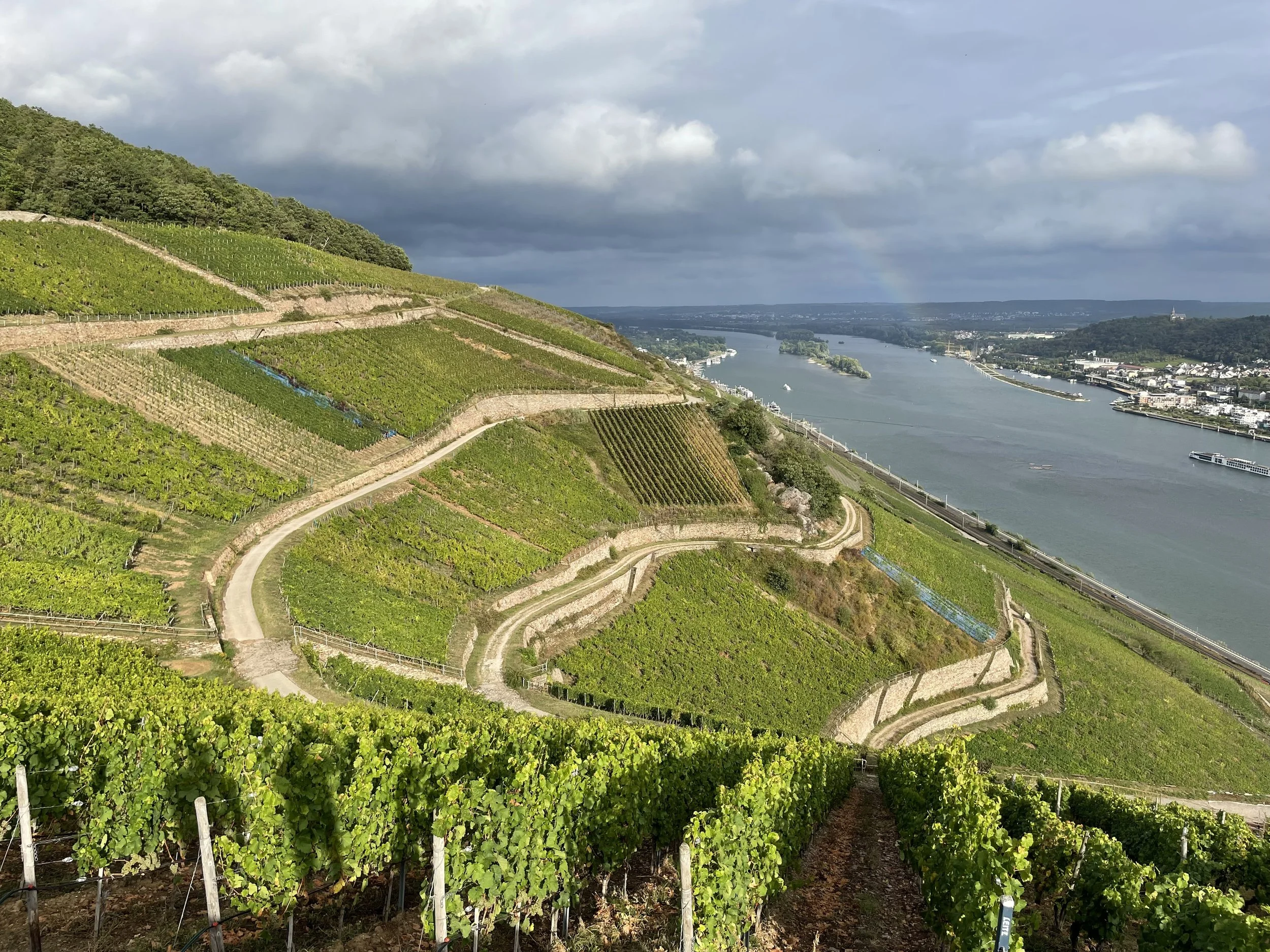
Berg Roseneck in Rüdesheim
“I’ve had the pleasure of tasting some of the Rheingau wines that my grandfather made,” he explains. “They strike me as being representative of a style that's been somewhat forgotten today, with a focus on a deeper sense of flavours and an unquestionable durability. Likewise, I want my wines to be ambassadors of the site and the soil, even if that comes at the expense of some immediacy.”
Indeed, in an earlier draft of this piece I describe Schregel wines as being definitively non-fruity, but I've been compelled to adjust my opinion on this point. Let's just say that fruit is not the point of Schregel's Rieslings, though it may denote contours or echo through flavours that are instead decidedly monumental in their primal earthiness. As a cultivar, Riesling is inordinately talented at transmitting what we might elusively refer to as “minerality", but Schregel's Rieslings go far beyond this to offer a panoply of terrestrial intrigue. One could say that they taste of melted rocks if one allowed their imagination to run in such directions.
“A ‘dry’ Riesling with five or seven grams of residual sugar is not dry,” Alex opines. His wines take “trocken” to the extreme, and yet their charming austerity has an analog tactile caress. Unconventionally, malolactic fermentation isn't blocked and his wines are neither fined nor filtered. The former point is almost imperceptible in the glass, but the delicate, almost indiscernible particulates resulting from the latter is anathema to the Rheingau tasting panel who usually reject his wines for “lack of typicity". Consequently, most of his cuvées are bottled under the lowly appellation of “Landwein,” and denied the right to showcase their site or village of origin. Alex's riposte is to leave the sites on the label, but with a scribble through them. It's yet another example of exceedingly site-expressive wine being denied the right to communicate to the consumer exactly where it's from… yet I can assure you that you won't be offended by the scant dusting of sediment in these wines!
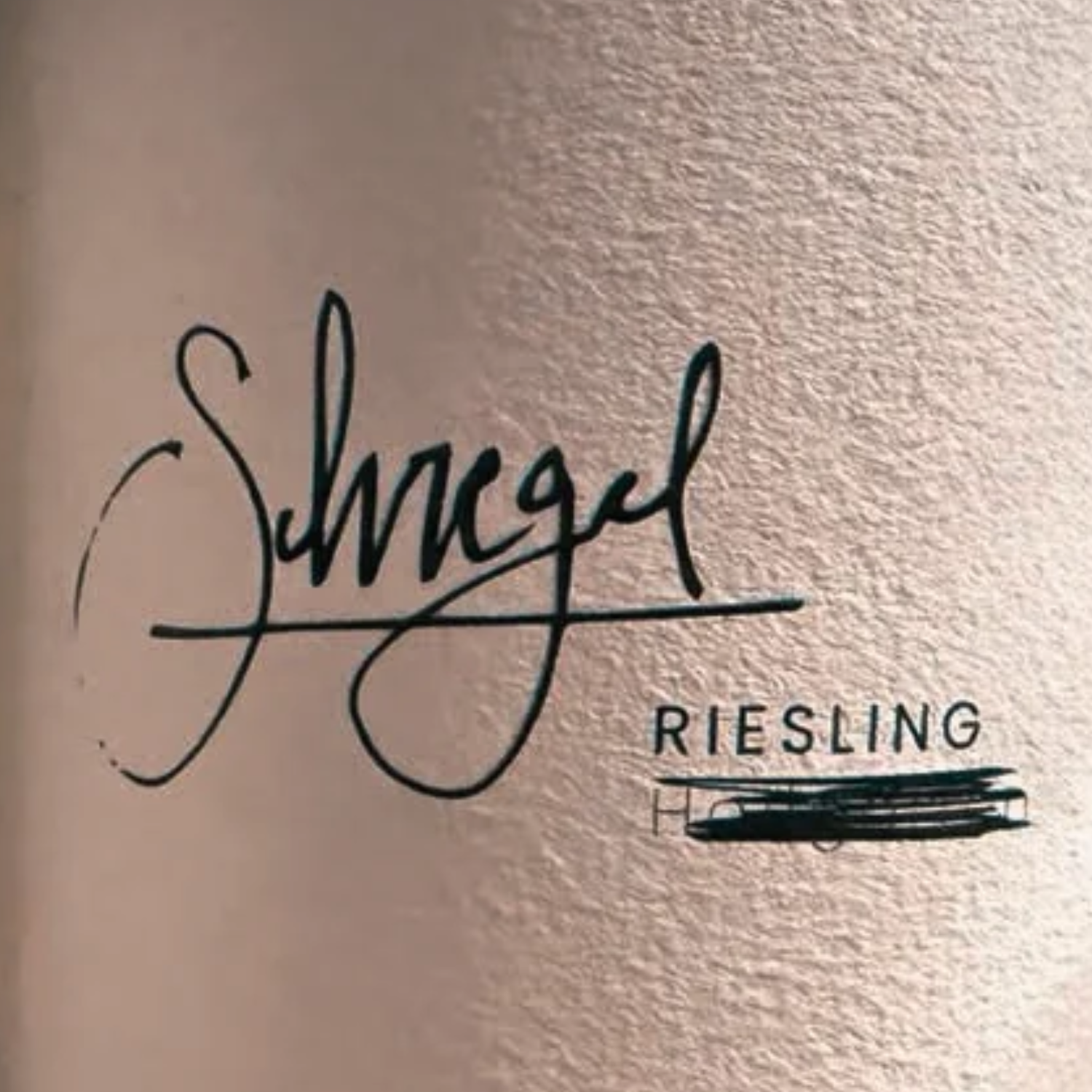
Having now had the opportunity to become intimately acquainted with these bottles in the comfort of my own home, I'm even more impressed by their understated complexity and surprising originality. They're best in a wineglass with a large bowl and their expressiveness is compromised at low temperatures. Along with my colleagues, I've noticed fascinating, non-linear arcs in development as the bottles are open for several days. (These experiments are of course to learn as much about the wines as possible, and my general default would be similar to yours—namely to open a bottle of wine and to drink it!). For example, the flavours unfold dramatically with air, only to play coy some hours later and run down different but arguably more exciting paths on the days that follow. At the time of writing, they seem to be at their most splayed and impressive on day four, although that doesn't preclude immeasurable enjoyment of the introductory Riesling immediately upon opening.
Regarding food, Schregel wines aren't going to be your default for Thai takeout or other exotic cuisine that German Riesling is stereotypically but often thoughtlessly paired to. Instead, pull a cork when you'd otherwise be opening Chablis, dry Chenin, mature Champagne, etc. And don't be afraid to stuff your cellar as the least of these wines is going to age admirably!
2024 Schregel Riesling Trocken - Rheingau $36
Comprised of fruit from the western extent of the Rheingau (80% from Rüdesheim, 20% from Lorch), this is a qualitatively spectacular, even altruistic “introductory” Riesling, of which I would cite Lafarge's Bourgogne Rouge or Cedric Bouchard's Val Vilaine as reference points for analogous quality in an entry point wine… but check out the price! A Riesling of glacial bombast and fluid orchestral complexity with merciless, sinewy power at a mere 11.5% alcohol, this is just as worthy of a by-the-glass listing as it is a spot in the darkest corner of your cellar—as you wish. Rarely does pixelating complexity and fundamental deliciousness intersect so effortlessly.
2024 Schregel Hallgarten Riesling Trocken $49
Somehow even more complex, with interwoven, fibrous sparks of lush alpine herbs and a panoply of sun-warmed stones—as if these nuances were purchasable like saffron threads and dissolved in a stoic, profound Rheingau Riesling. The altitude whispers a tone poem of wintergreen and sweet conifer, delicately poised upon tightrope acidity and I'm instantly reminded of how deserving the winegrowing village of Hallgarten is of my present fascination. I would once again argue that the value here is inestimable, and though you can get into it now, I must concede that its best days lay ahead.
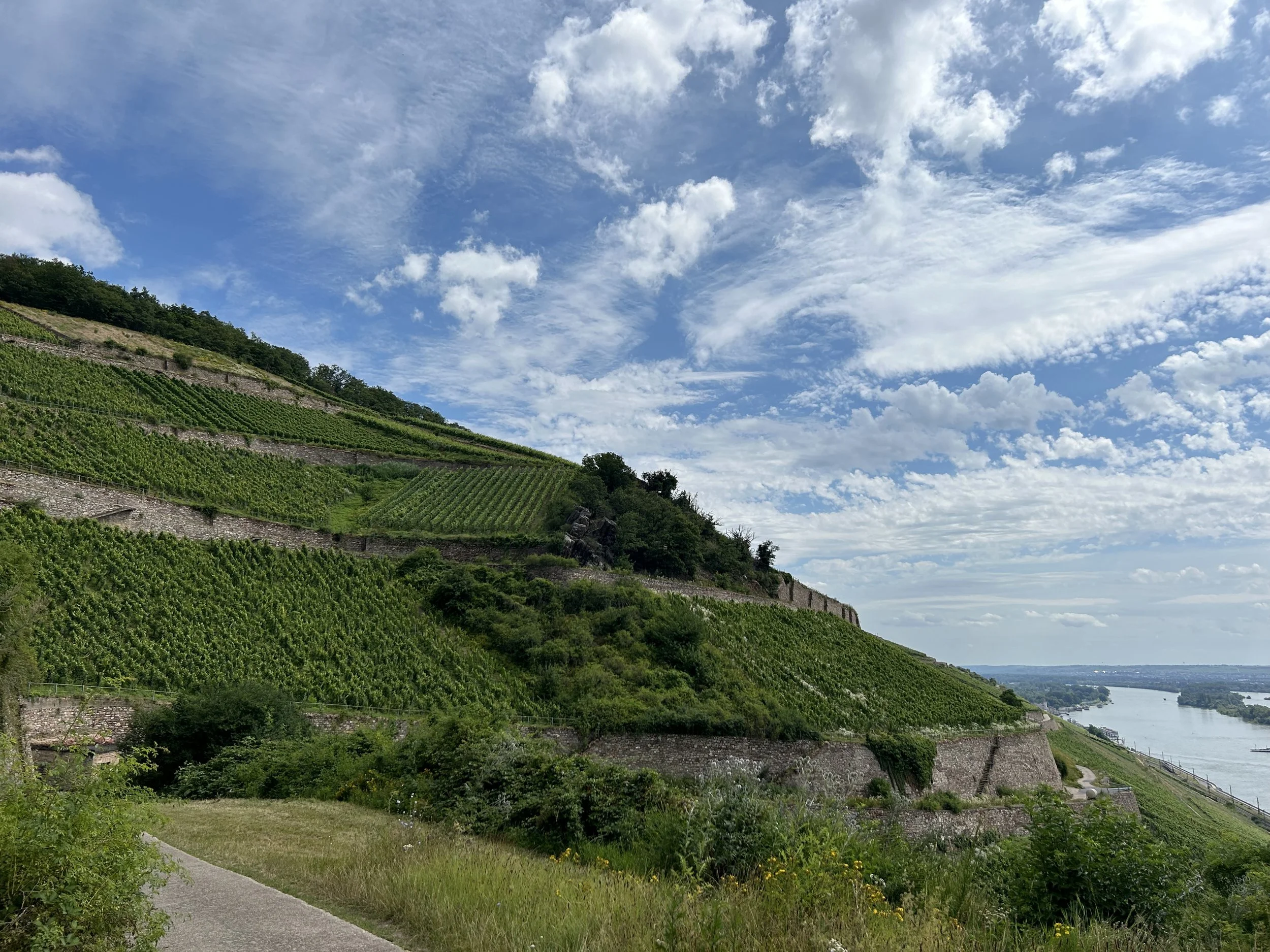
2024 Schregel Rüdesheimer Berg Roseneck Riesling Trocken $113
Were Schregel a member of the VDP, this would be a GG, and among the very best of the vintage. Along with the house style that I've attempted to comprehensively summarise as being stoney in the most monolithic sense, there's a wafting, lilting, creamy florality, particularly in regard to aromas and retronasal definition. Schregel's Roseneck embodies the important hallmarks of this legendary vineyard—a dewy tenderness of fruit, an evocative exhalation of rose oil—but expresses them in an original and exciting way. This wine is eminently worthy of a place in your cellar and will immeasurably reward being forgotten for a decade or two, but please note that its short term recompense would primarily be academic. It simply needs time to unfold.
We are offering 15% off these prices until Sunday November 15.
